A high pressure washer turns a modest flow of water into a cutting jet, and on an Indian farm that jet does work no brush and bucket will do: caked black soil off a tractor underbody, dung off a dairy shed floor, chaff and grease out of a thresher, chemical residue off a sprayer tank before the next crop. The buyers are farmers washing their own machinery, dairy and poultry owners cleaning sheds every morning, and car and bike wash bays that run the machine for hours a day.
How to choose a pressure washer
Two numbers decide everything, and they pull in opposite directions. Pressure, quoted in bar or MPa, breaks the bond between the dirt and the surface. Flow, quoted in litres per minute, carries that loosened dirt away. A machine with high pressure and low flow cuts a narrow stripe clean and is slow over a large panel. A machine with lower pressure and high flow covers ground fast but will not shift baked-on mud.
For vehicles, light machinery and household surfaces, pressure matters more and a compact electric unit in the 70 to 100 bar band is the right answer. For wash-down of floors, sheds, trolleys and implements, where the area is large and the soiling is loose, a plunger pump set moving 13 to 22 litres a minute at 20 to 40 bar clears far more square metres per hour even though the headline pressure is lower.
After that, decide on hours per day. A washer used for twenty minutes on a Sunday and a washer used for six hours in a commercial bay are different machines, whatever the rating plate says, because the pump seals and plungers wear on running hours. Then check your supply: a single phase three pin socket limits you to the electric unit, while a pump set needs a motor or engine drive and a tank or open channel it can draw from. Finally pick the nozzle, because the same pump cleans very differently through a pencil jet than through a fan cap.
What JP Kissan supplies
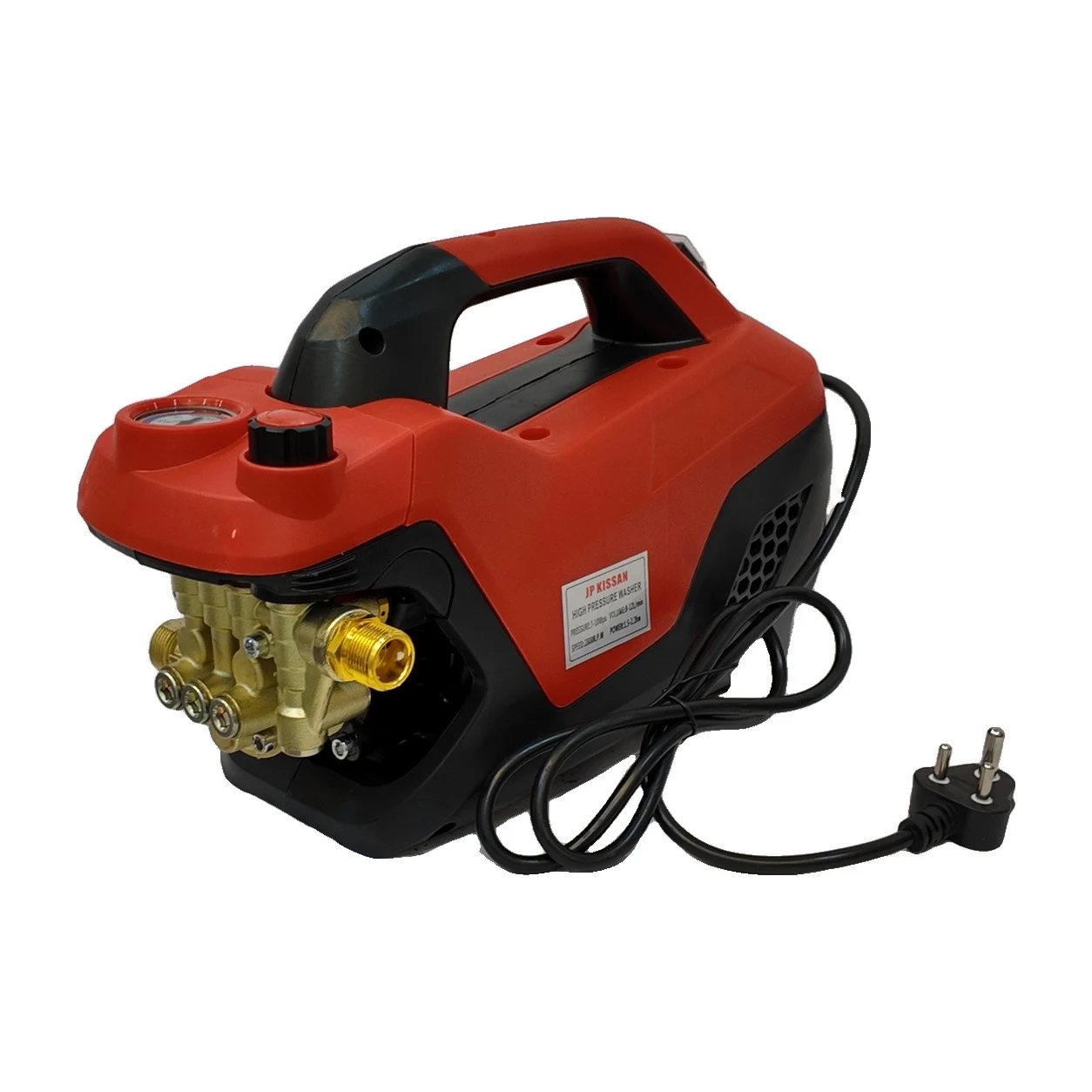
The JP Kissan Electric High Pressure Washer is the plug-in machine in the range. It is rated 7 to 10 MPa, which is 70 to 100 bar, at 2800 rpm on a 1.5 to 2.2 kW electric motor, with a brass pump head and a standard three pin plug. That combination suits car and two-wheeler washing, bike and tractor bodywork, verandah and courtyard floors, and any job where you have a socket and a tap within reach.
Where the duty is heavier and the surface is bigger, the triplex plunger sets take over. The JPK-160L is the largest, a trolley mounted set with a 160 litre tank running 20 to 40 bar at 13 to 22 litres a minute on a 6.5 to 7.5 kW drive, with three 22 x 16 mm plungers at 800 to 1200 rpm. At 68 kg and 1300 x 630 x 730 mm it stays where it is wheeled and suits a yard, a dairy or a workshop that washes something every day.
The JPK-QF-C2 covers the same 20 to 40 bar and 13 to 22 litres a minute on a smaller 1.5 to 2 HP motor, weighs 28 kg and measures 790 x 390 x 430 mm. The JPK-QF-B1.5 is the same pump on a fixed 1.5 HP motor at 27.5 kg and 740 x 390 x 430 mm. Both are light enough to lift onto a trolley or a pickup, which matters if the washing happens in more than one place. All three share the three-plunger pump used across our HTP power sprayers, so wear parts are common and a dealer who stocks for the sprayer already stocks for the washer.
What affects the price
Price moves with the pump rather than the badge. A larger plunger set, a bigger drive motor and a tank and trolley all add cost, which is why the 160L sits well above the compact electric unit. Brass in the pump head costs more than aluminium and lasts longer in hard water. Gun, lance and hose length are quoted separately because a wash bay needs a longer hose than a farmyard. Dealer and bulk quantities are priced differently from single units. We do not publish a figure for these machines: pricing is on enquiry through your nearest dealer, against the model and the configuration you actually need.
Where it is used
A sugarcane or paddy grower brings a tractor and rotavator in at the end of the season with soil packed into the tynes; an hour with a washer removes what two days of soaking will not. A dairy with twenty animals washes the standing area and the milking parlour twice a day, where flow matters more than pressure and a pump set pays for itself in labour. A village car and bike wash bay runs continuously from morning to evening, and there the choice is driven entirely by how long the pump will hold its seals.
A practical note on water supply
More washers fail from starvation than from overload. A plunger pump has to be fed; if it draws air because the tap is slow, the tank is low or the suction filter is choked, the plungers run dry and the seals are gone in minutes. Feed the machine from a drum or overhead tank rather than directly off a weak municipal line, keep the suction strainer clean, and never let the machine run with the trigger shut for more than a minute at a time, because the bypassed water heats up fast. Check the gun and nozzle before blaming the pump: a worn nozzle widens, the jet spreads and the machine feels weak when nothing is wrong with it. Brass cocks and joints at the pressure connections survive vibration that cracks moulded fittings, and replacement wear parts for the plunger pumps are stocked.