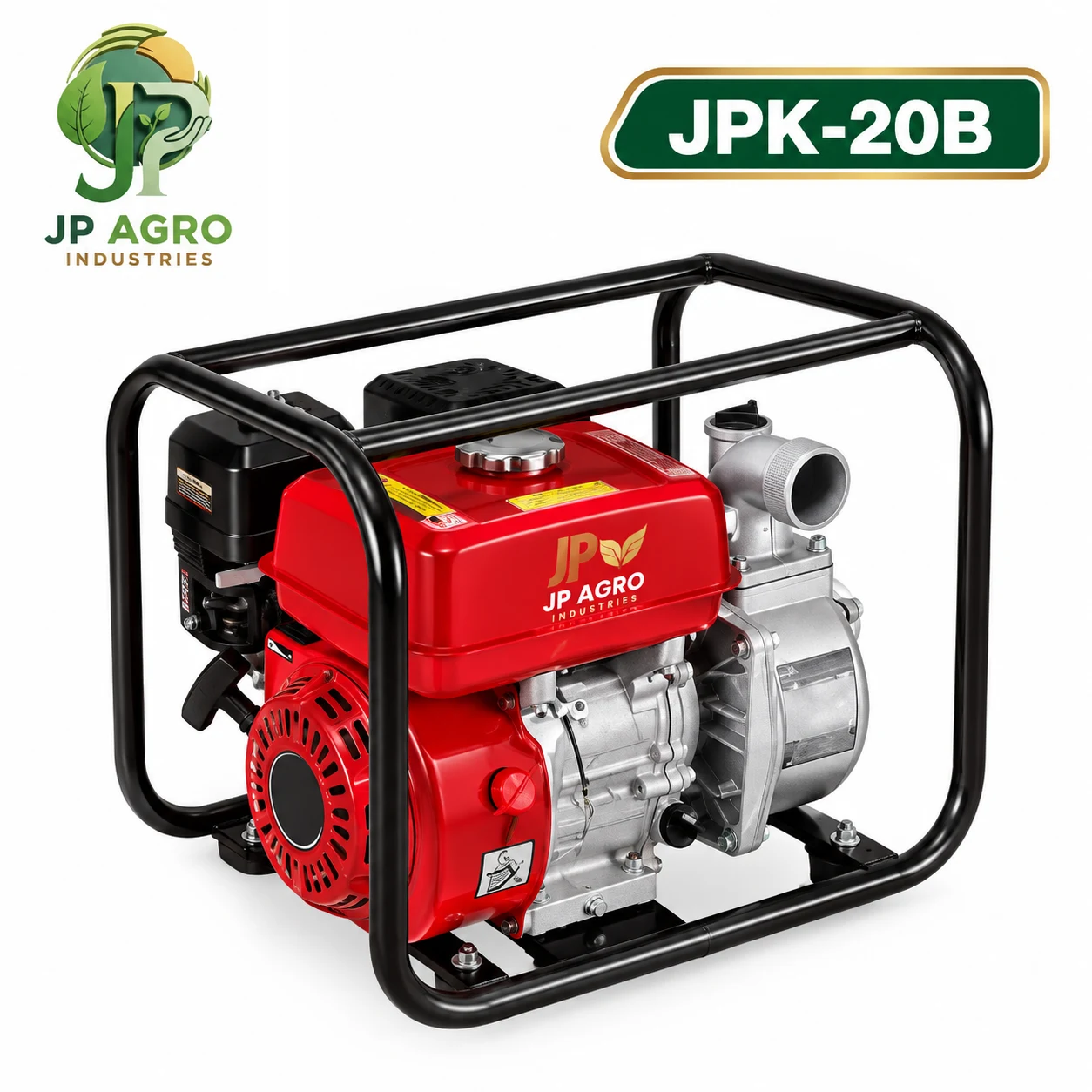
An agriculture water pump is a petrol-engined self-priming pump on an open frame. It draws from a well, a canal, a pond or a farm tank and pushes water out through a hose to the field, and it runs where there is no electricity at all, which means load shedding and low voltage never stop it. Farmers irrigating from an open source, growers filling spray tanks and sprinkler lines, and contractors who carry one pump between several plots are the usual buyers.
How to choose an agriculture water pump
Size the pump on delivery and lift, not on horsepower. Two numbers decide everything: how many litres a minute you need at the field end, and how many metres the water has to rise from the water surface to the discharge point. Engine rating follows from those two; it is not the figure to buy on.
Start with the bore size, because that sets the flow. A 2 inch inlet and outlet suits a short line to a nearby plot, filling spray tanks and running a small sprinkler set. A 3 inch moves considerably more water and is what you want for flood irrigation over a larger area or for a long delivery run, where a narrow pipe simply throttles the pump no matter what is driving it.
Then check suction height, which is the vertical distance from the water surface up to the pump itself. This range lifts 8 metres on suction. If your well water drops below that in April and May, no surface pump of any size will prime, and the answer is to lower the pump closer to the water rather than to buy a bigger engine.
Total lift is the other hard limit: 26 metres maximum on the 2 and 3 inch models. Measure the real rise from water surface to the highest point on your line, and allow for friction loss in a long or narrow hose, which eats into the lift you have on paper before any water reaches the crop.
Finally, match the pipe to the pump. An oversized pump on an undersized delivery line wastes fuel and runs hot; an undersized pump never reaches the far end of the field. Give the dealer the distance, the rise and the litres per minute you need, and let the model follow from that.
The models JP Kissan supplies
Three petrol water pump models cover the range.
The JPK-20B has a 2 inch inlet and outlet and delivers 20 litres a minute, with a maximum suction of 8 metres and a maximum lift of 26 metres, running at 2000 to 3200 rpm on an engine rated 5.5 to 7.5 HP. It weighs 23 kg and measures 520 x 380 x 450 mm, which is a two-man lift onto a cart or a pickup. This is the model most small holdings take for tank filling and short irrigation runs.
The JPK-30B is the same machine stepped up to a 3 inch inlet and outlet, delivering 50 litres a minute at the same 8 metre suction, 26 metre lift and 5.5 to 7.5 HP rating, in the same 23 kg, 520 x 380 x 450 mm package. Two and a half times the flow for the same weight and the same engine rating is why most buyers irrigating any real area take the 3 inch.
The JPK-35 is the light-duty unit, carrying a Jx35 power unit with a maximum head of 27 to 30 metres. It is the machine for a small plot, a kitchen garden or filling a tank for an agriculture spray pump, and it is a one-man carry rather than a field irrigation pump.
Running cost and what affects the price
Pricing is on enquiry through a dealer; no rupee figures are published for these pumps. Outlet size and engine rating move the price most, so the 3 inch unit sits above the 2 inch even though the engine rating is the same on both. After that it is build: the impeller and volute casing, the mechanical seal and the frame are where cost shows, and they also decide whether the pump survives silty water. Running cost is petrol, engine oil and the occasional seal. Suction hose, foot valve and delivery hose are usually bought alongside the pump and are worth budgeting for, and spare parts availability is worth confirming before you buy.
Where an agriculture water pump is used
The commonest use is lifting from an open well or a farm pond into a field channel for flood irrigation. The pump stands on the parapet, the suction hose and foot valve go down to the water, and the delivery hose runs out to the channel head.
The second is filling: topping up the tank of a power sprayer, filling the storage tank that feeds a drip system, or filling cattle troughs. For this duty the 2 inch pump is usually enough and the smaller unit is easier to carry.
The third is drainage. After heavy rain a petrol pump clears standing water off a low field or out of a polyhouse bay, which is work that has to happen the same day and cannot wait for a power connection or a technician.
Priming and seasonal checks
A self-priming pump still has to be primed by hand the first time. Fill the pump casing through the priming plug until water stands at the top, close the plug, and only then start the engine. Running the pump dry even for a minute burns the mechanical seal, and that is the single most common way these machines are damaged.
Almost every pump that will not prime is losing air on the suction side rather than failing on the pressure side. Check three things in order. First the foot valve at the bottom of the suction hose, which silts up and sticks open. Second the suction hose itself, which must be a rigid-walled hose that does not collapse under vacuum. Third the joints and clamps, where one loose clip admits enough air to stop priming completely. A suction leak shows no drip, because it draws air in rather than pushing water out, which is why it gets missed.
Before each irrigation season change the engine oil, clean the air filter and clear the strainer. At the end of a silty job, run the pump on clean water for a few minutes so grit does not dry inside the casing against the impeller and the seal face.