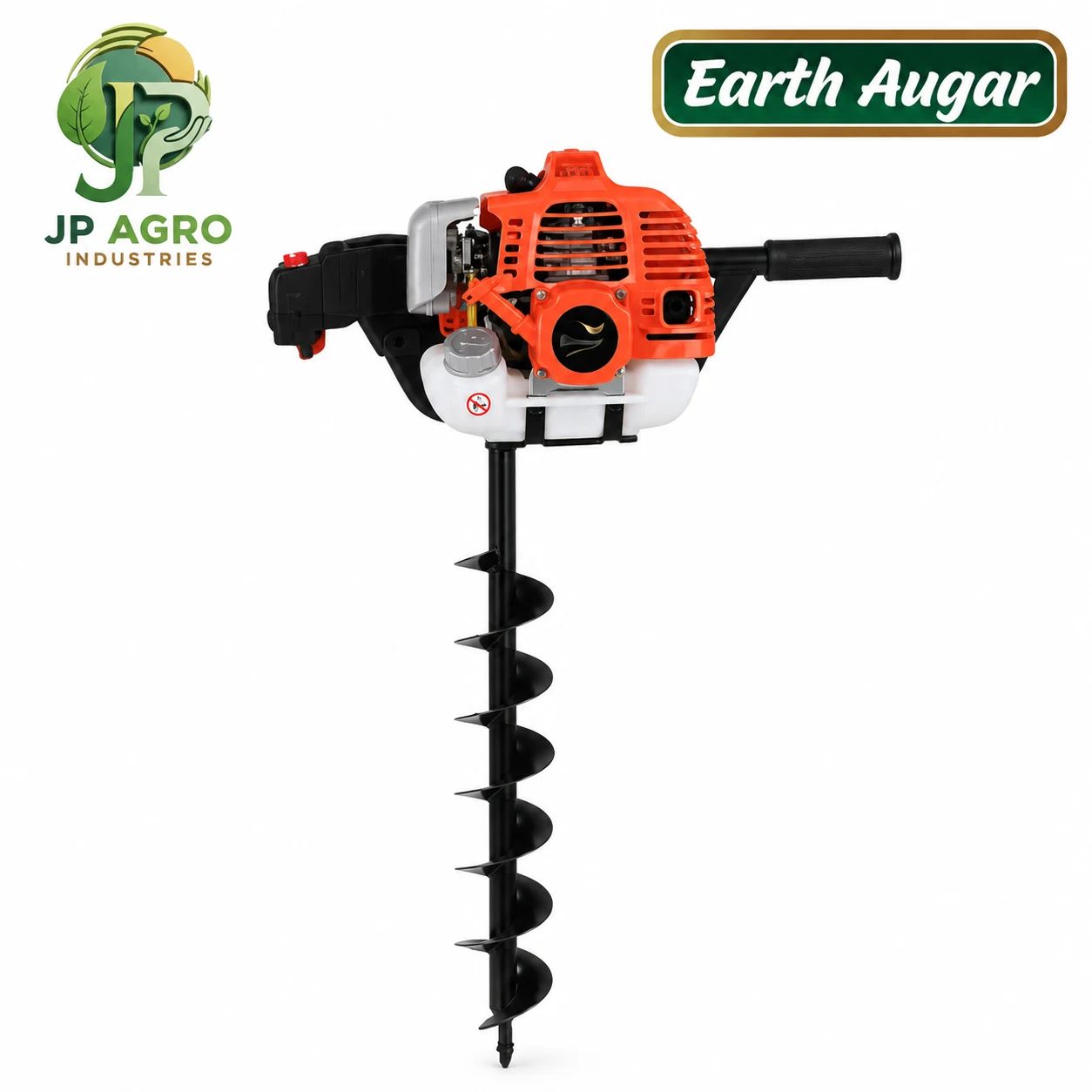
Earth Auger & Post Hole Digger — models and specifications
| Model | Matched Engine | Displacement | Rated Output Power | Drill Diameter | Drill Length | Mixed Fuel Ratio |
|---|---|---|---|---|---|---|
| Manual Auger & Drill Bits | ||||||
| JP-KISSAN Earth Auger | 1E44F-5 | 49CC | 1.65KW / 2.2HP | 100mm | 80cm | 25:1 |

JP Kissan earth auger and post hole digger, 49cc at 1.65 KW, drill diameters from 100 mm to 300 mm.
An earth auger is a petrol-engined post hole digger: a helical steel bit on a geared head that drills a clean vertical hole in a minute or two instead of twenty minutes of crowbar and phawda work. On Indian farms it is bought for planting pits in orchards and nurseries, post holes for cattle and solar fencing, uprights for shade nets and bird perches, and foundation holes for sheds and gates. Fencing contractors and drip and shade-structure installers are the other steady buyers.
Bore diameter is the first decision, and it is set by what goes into the hole. An 80 or 100 mm bit takes a fence post or an angle iron. A 150 or 200 mm bit covers most boundary fencing and shade-net poles with room for concrete around the post. A 300 mm bit is for planting, and takes a nursery sapling with its root ball intact, which is the size an orchard planting season actually needs.
Drill length is the second. The standard bit is 80 cm, which is deeper than most fence posts require. Go to 100, 120 or 140 cm only if you are setting saplings that root deep, or posts that must stand against wind and cattle pressure. A longer bit in hard ground also means more torque returning through the handles, so do not buy length you will not use.
Soil decides more than the specification sheet does. In worked loam or sandy soil the machine drills continuously and one operator can manage. In black soil that has dried and set, in murram, or in ground full of old roots and loose stone, the bit binds, and when the bit stops the engine tries to turn the operator instead. On that kind of ground this is a two-man machine and no amount of engine size changes it.
Finally, decide between powered and manual. For a few dozen holes a season in workable soil, a manual auger has no engine to fuel or service, costs a fraction as much and is far more controllable among stones. For a planting season or a fencing contract, the petrol machine is the only sensible answer.
The powered unit is the JP-KISSAN earth auger, built around a matched 1E44F-5 engine of 49cc rated at 1.65 KW, or 2.2 HP, running on a 25:1 mixed fuel ratio. It is supplied as standard with an 80 cm drill at 100 mm diameter, which is the fencing configuration, and weighs 10.50 kg net and 12.50 kg gross, so it travels on a motorcycle or in the back of a jeep without difficulty.
The same head accepts optional drills in 80, 100, 120 and 140 cm lengths and in 80, 100, 120, 150, 200 and 300 mm diameters, so one machine covers both fencing and planting provided you buy the bits for both. Most buyers take the 80 cm head with a 150 or 200 mm bit for post work and add a 300 mm bit before the planting season starts.
Alongside it we supply manual augers and drill bits. A hand auger works on body weight and rotation rather than engine torque, which makes it slower but considerably safer where the ground is stony, because if the bit catches there is nothing driving it. The bits fit both the manual and the powered head, so what you buy for one carries across to the other and nothing is wasted if you later add a machine.
Pricing is on enquiry through a dealer and depends on the configuration you order. Engine and gearbox account for most of the cost of a powered unit, and the drill bits are quoted separately, so a 30 cm planting bit is a meaningful addition to the machine price. Decide your bit sizes before asking for a quote. Manual augers are quoted separately again and cost far less. Running cost is mixed fuel plus bit wear: the cutting blades and the pilot point at the tip are the parts that go, faster in murram and stony soil than in loam, so check spare parts availability at the time of purchase rather than mid-season.
At orchard planting time for mango, guava, pomegranate or citrus, a 30 cm bit opens pits along a marked line far faster than a team with crowbars, and every hole comes out the same depth, which matters for even establishment across a block.
On fencing work, whether a cattle fence around a plot or a solar fence line, a 15 or 20 cm bit sets posts at even spacing on a true line, and one contractor with a machine covers a boundary in a day that would otherwise take a week by hand.
For shade nets, polyhouse frames, drip line supports and bird perches, the auger drills the foundation holes for the uprights without disturbing the soil around them, so concrete sets against undisturbed ground rather than loose backfill.
The real risk with a powered auger is torque, not the blade. If the bit meets a stone or a root the drill stops and the engine tries to spin the machine, taking the operator with it. Release the throttle the instant the bit binds, keep your feet apart and braced, and never put your arm through the handle frame. On hard or unknown ground, run it as a two-man machine with one operator on each handle.
Drill in stages rather than driving straight down to full depth. Go down about a third, lift the bit clear to shed the spoil, then go again. A bit packed solid with soil binds, and clearing a jammed bit out of a deep hole is where most of the trouble starts.
The engine is two stroke and takes a 25:1 petrol and oil mix, made up in a can before fuelling, never poured separately into the tank. Keep the gearbox oil topped up, and check that the locking pin holding the bit to the output shaft is in and secure before every start, because a bit that comes free under load is dangerous. Boots, gloves and eye protection are worth wearing: a powered auger throws grit.
| Model | Matched Engine | Displacement | Rated Output Power | Drill Diameter | Drill Length | Mixed Fuel Ratio |
|---|---|---|---|---|---|---|
| Manual Auger & Drill Bits | ||||||
| JP-KISSAN Earth Auger | 1E44F-5 | 49CC | 1.65KW / 2.2HP | 100mm | 80cm | 25:1 |
Pricing is on enquiry through a dealer, because it depends on the head, the drill bits ordered and the quantity. Powered units, manual augers and drill bits are quoted separately. Send the configuration and quantity you need and you will have a quotation the same working day.
Match the bit to what goes in the hole. 10 cm takes a fence post or angle iron; 15 and 20 cm cover most fencing and shade-net poles with room for concrete; 25 and 30 cm are planting sizes, with 30 cm taking a nursery sapling with its root ball intact. Diameters of 10, 15, 20, 25 and 30 cm are available for this head.
The standard drill is 80 cm long, which is deeper than most fence posts need. Optional drills are available at 80, 100, 120 and 140 cm. Real depth also depends on ground condition: in dry, compacted or stony soil the bit works slower and binds more often than in worked soil.
In soft or recently worked soil, yes. On compacted black soil, murram or ground full of stones and old roots, run it with two operators, one on each handle. When the bit binds, the torque comes straight back through the frame, and a second pair of hands is the difference between a stopped drill and an injury.
A 25:1 mixed fuel ratio, meaning one part two-stroke oil to twenty-five parts petrol. Mix it in a clean can before filling the tank. Plain petrol will seize the 49cc engine, and over-oiled fuel fouls the plug and smokes.
If you dig a few dozen holes a season in workable soil, a manual auger is the sensible tool: nothing to fuel or service, far cheaper, and much safer among stones because nothing is driving the bit when it catches. For a planting season or a fencing contract, buy the powered unit. The drill bits fit both heads, so bits bought for one are not wasted.
We supply dealers, distributors and institutional buyers across India from our New Delhi works. Send us your requirement for dealer pricing and delivery terms.
4.8 out of 5 · 5 reviews on Google
Best quality.
Wide range of products. Quality products.
Good quality.
Nice range of agro pumps and good service by the staff.
Good quality product and talented staff.
Partner with J.P Agro Industries (India) for reliable equipment, dealer pricing and pan-India supply.