A chain saw machine cuts timber with a loop of steel cutters driven around a guide bar by a petrol engine. On an Indian farm it handles the jobs that cannot wait: felling and cross-cutting eucalyptus, poplar and subabul on a plantation, clearing a fallen tree off a bund after a storm, pruning mango and coconut after harvest, and cutting firewood. Plantation owners, orchard growers, timber contractors and the operators who hire themselves out with their own saw are who buy them.
How to choose a chain saw machine
Choose the guide bar first. The bar has to be longer than the timber is thick, because a bar that is too short forces you to cut from both sides of the trunk, and that is where mistakes and pinched bars happen. A 20 inch bar handles most farm timber and orchard work. A 25 inch bar covers larger plantation trunks. A 36 inch bar is for genuinely big felling and nothing smaller.
Engine displacement follows the bar. A longer chain carries more cutters through the wood and takes more power to pull, so a long bar on a small engine bogs in the cut and the saw feels useless even though nothing is wrong with it. This range pairs the two deliberately: 59cc and 61.5cc on 20 to 22 inch bars, 72.2cc up to 25 inches, and 105cc on 36 inches.
Then weigh the saw against the working day. The 59cc, 61.5cc and 72.2cc machines all come in at 6.0 kg net, which is a saw you can still hold up for pruning cuts. The 105cc machine is 18 kg net; that is a two-handed ground saw for felling, not something to lift or work above waist height.
Every model here is a two-stroke, air-cooled engine running a 1:25 oil and petrol mix. Two stroke is still standard on saws because the engine has to run at any angle, including inverted in an undercut, which a four stroke sump cannot do.
Last, note chain pitch and gauge, because replacement chains must match them exactly. The 59cc, 61.5cc and 72.2cc machines use a 3/8 inch pitch; the 105cc uses 0.404 inch. Gauge is 0.058 or 0.063 inch depending on the model.
The models JP Kissan supplies
Four petrol chain saw models cover the range from orchard pruning to large felling.
The JPK-MS361 is 59cc producing 3.4 Kw, supplied with a 20 inch or 22 inch bar on 3/8 inch pitch and 0.063 inch gauge, with a 690 ml fuel tank and a 330 ml chain oil tank. At 6.0 kg net it is the saw to pick for a long day of orchard pruning and general farm cutting where you are moving tree to tree on foot.
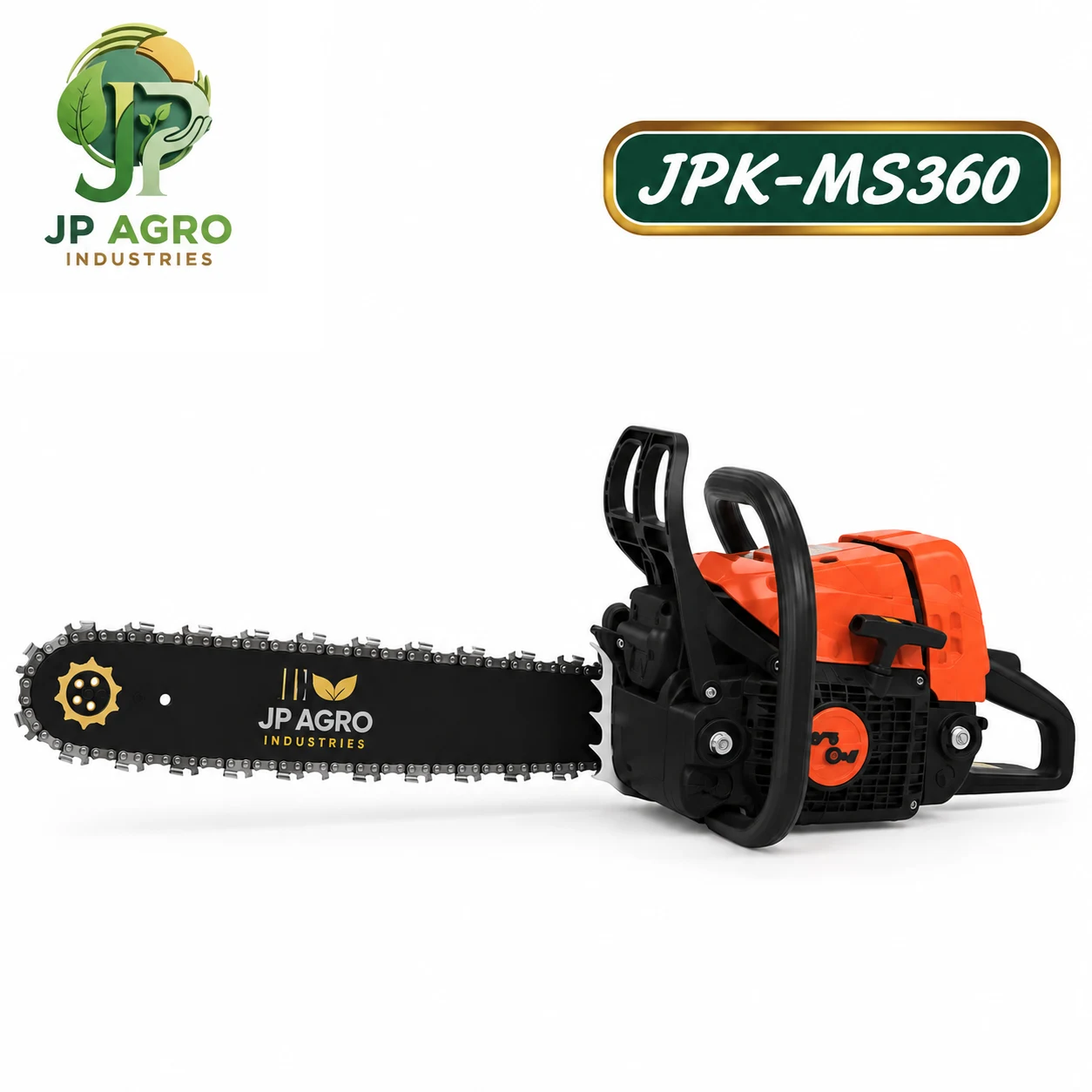
The JPK-MS360 is 61.5cc, also 3.4 Kw, on a 20 inch bar with 3/8 inch pitch and 0.058 inch gauge, a 625 ml fuel tank and a 320 ml oil tank, again 6.0 kg net. The larger displacement on the same bar length gives a quicker cut in hardwood, which makes it the usual choice for farm timber and firewood.
The JPK-MS380 steps up to 72.2cc and 3.6 Kw and takes an 18, 20 or 25 inch bar on 3/8 inch pitch in either 0.058 or 0.063 inch gauge, with a 580 ml fuel tank and a 310 ml oil tank, still at 6.0 kg net. This is the plantation saw: enough engine to drive a 25 inch bar through eucalyptus or poplar, and light enough to work with all day.
The JPK-MS070 is the felling machine. It is 105cc producing 4.8 Kw on a 36 inch bar, 0.404 inch pitch and 0.063 inch gauge, with a 1200 ml fuel tank and a 530 ml oil tank, at 18 kg net. Buy it only if you are cutting trunks a 25 inch bar will not reach through, because for everything else the weight tells against you by midday.
Running cost and what affects the price
Prices are not published here; a dealer quotes against the model and quantity you want. Price moves with engine displacement first and guide bar length second, so the 105cc machine sits well above the 59cc one. Build decides the rest, and the cylinder, crankshaft bearings and clutch drum are what separate a saw that lasts several seasons from one that does not. Your real running cost is not fuel but chains, bars and sprockets, which are consumables on farm timber. Before buying, confirm the dealer stocks chains in your pitch and gauge, and keep a spare chain and a bar file in the spare parts box.
Where a chain saw is used
On a eucalyptus, poplar or subabul plantation the saw fells the stand and cross-cuts it to the lengths the mill or the paper buyer specifies, which is most of a timber contractor's year.
In a mango, guava or coconut orchard the same saw takes out dead and crossing wood after harvest and removes an old tree that has stopped bearing, work that a smaller bar and a lighter machine handle better than a felling saw would.
After a storm, a tree down across a field bund or the approach road is a saw job and nothing else. That is the reason petrol still wins on a farm: there is no cable to run to the far boundary and no generator to carry.
Fuel mix, chain tension and safety
Mix fuel at 1:25, one part two-stroke oil to twenty-five parts petrol, and mix it in a can, not in the tank. Running a two stroke on plain petrol seizes it, usually within the hour, and no warranty covers that. Mix only what you will use within a few weeks, because petrol that has stood for months gums the carburettor.
Set chain tension cold with the bar nose lifted. The chain should sit against the underside of the bar but still pull round by hand with a glove on. A chain tensioned while hot will bind as it cools; one left slack can jump off the bar under load.
Fill the chain oil tank every time you fill fuel, as the two tanks are sized to run out together. A dry bar discolours, and the chain stretches permanently. Keep the chain sharp as well: most saws described as underpowered are simply blunt, and a blunt chain throws dust instead of chips, heats the bar and grabs in the cut.
Work with both hands on the saw, keep cuts below shoulder height, and keep the tip of the bar out of the wood, because tip contact is what causes kickback.